Optical Micromanipulation
Leader: Monika Ritsch-Marte, Gregor Thalhammer-Thurner
Optical micromanipulation exploits the fact that light carries energy, momentum, and, under certain conditions, angular momentum. This allows light to be used as a tool to trap, hold, move, or deform micrometer-sized particles.
We develop new concepts for holographic optical tweezers that are specifically tailored to particular applications and enable quantitative measurements of the acting optical forces (typically in the piconewton range)
- Strasser, F., Moser, S., Ritsch-Marte, M. & Thalhammer, G. Direct measurement of individual optical forces in ensembles of trapped particles. Optica 8, 79–87 (2021), https://doi.org/10.1364/OPTICA.410494.
- Strasser, F., Barnett, S. M., Ritsch-Marte, M. & Thalhammer, G. Generally Applicable Holographic Torque Measurement for Optically Trapped Particles. Phys. Rev. Lett. 128, 213604 (2022), https://doi.org/10.1103/.
Holographic force and torque measurements
We have developed methods to measure forces and torques in holographic optical tweezers that rely on analyzing the changes in the trapping light. These methods are based on concepts from holography and enable a complete reconstruction of the phase and amplitude of the trapping light in the far field, after interaction with trapped specimens. Compared to conventional methods for measuring forces (imaging-based or back focal plane interferometry), our approach demonstrates significant improvements:
- Our direct force and torque measurement methods are calibration free, i.e. need no information about particle shape and optical properties of the particles or the shape, as it directly measures how much momentum is transferred to a specimen.
- This makes it well suited to measure forces and torques acting on biological specimens such as cells with (often unknown) complicated structure.
- It gives complete information about direction of force and torque.
- This technique facilitates the reconstruction of individual forces exerted on multiple simultaneously trapped particles (demonstrated for up to 10 particles). This capability enables the utilization of the flexibility of holographic optical tweezers for force and torque measurements.
Holographic wavefront shaping with liquid crystal spatial light modulators (LC-SLM)
We use liquid crystal based Spatial Light Modulators (LC-SLMs) to holographically shape light in dynamic manner. Due to the unique combination of (up to) millions of pixels and precise control of the phase these devices are powerful tools to efficiently create complex light fields with high detail. However, LC-SLMs show some technical limitations with regard to uniformity, switching speed, and cross talk between boundaries. We developed methods to improve these issues, making these liquid crystal based spatial light modulators better suited to a broader range of applications:
LC-SLM Aberration correction
Based on precise measurements of the modulation characteristic for each pixel we correct for inhomogeneous response of the SLM, enabling accurate realization of wavefronts with low aberrations.
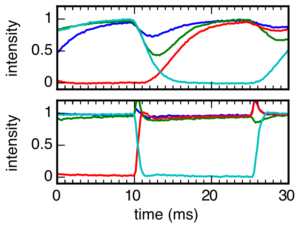
High speed pattern switching
By a combination of two methods (voltage overdrive and phase change reduction) we significantly increased the switching speed and reduced transients during switching. [zotpressInText]
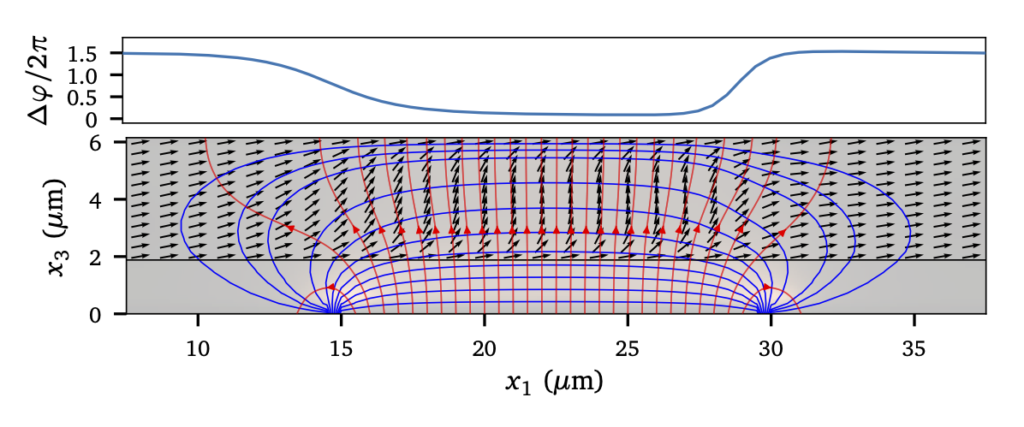
Pixel crosstalk modelling and compensation
Between neighbouring pixels of a liquid crystel SLM there is some cross talk due to electric field fringing and elastic interactions of the liquid crystals. Based on a detailed numerical model of the SLM, we developed a method to accurately predict the realized wavefront modulation at high speed (< 20 ms), which in turn helps to significantly reduce errors in holographic wavefront shaping.